Showing posts with label 俄罗斯. Show all posts

Wednesday, May 30, 2018

Remembrance: Red Army’s role in liberating Europe

RTD | RTD | Remembrance. Rewriting history: Red Army’s role in liberating Europe censored in the West

Thursday, April 26, 2018

CGTN: China-Russia relationship

CGTN | What Western media won’t tell you about the China-Russia relationship | Mar 2018 |
北京卫视官方频道 , WUWU秀

Saturday, April 14, 2018

Vasili Arkhipov, The Man Who Saved the World

Secrets of the Dead | Vasili Arkhipov, The Man Who Saved the World |
SEE: Васи́лий Алекса́ндрович Архи́пов

Friday, April 13, 2018

Will U.S. action in Syria lead to conflict with Russia?

Fox News | Will U.S. action in Syria lead to conflict with Russia? | Apr 2018

Wednesday, March 21, 2018

Britain stages Russia poisoning

Inessa S | Britain stages Russia poisoning, drowns in lies | Mar 2018 | Twitter

Friday, March 16, 2018

Interview of Putin with NBC's Megan Kelly

NBC News | UNEDITED Interview of Putin with NBC's Megan Kelly | Mar 2018 | Transcript , Transcript

Sunday, March 11, 2018

US Misses Putin’s Nuclear Message

The Real News | US Misses Putin’s Nuclear Message (1/2) | Mar 2018 | Part 2

Wednesday, March 7, 2018

Teachers will ensure Russia's Future

Russia Insight | Teachers will ensure Russia's Future | Mar 2018 | Владимир Соловьё́в

Difference between USA & Russia

Russia Insight | Difference between USA & Russia | Dec 2017 | Владимир Соловьё́в

Sunday, August 20, 2017

Why We Fight: The Battle of Russia

US National Archives | Why We Fight: The Battle of Russia | National Archives

Tuesday, July 4, 2017

Russian Female Dance: Beriozka

Russia Insider | Russia Insider Youtube Channel |

Song: The Sacred War

Russia Insider | Russia Insider Youtube Channel |

Russian Folk Music

Russia Insider | Russia Insider Youtube Channel |

Sunday, July 2, 2017

National Anthem of Russia

National Anthem of Russia | Crimea | Sochi:Сочи-2014 | Español | Ру́сский:Ру́сский | 2c:2c:2c |

Saturday, May 6, 2017

Maria Zakharova: Do Russians want War?

MFA | Complete Interview. In The Now, Feb 2016 | Song:Song |

Tuesday, March 28, 2017

Putin Documentary: "President"

Putin Documentary: President | 2c | 2015

Sunday, October 16, 2016

Russia's First Year Of Operations In Syria

Written and produced by SF Team: J.Hawk, Daniel Deiss, Edwin Watson

To put Russia’s one year of peacemaking operations in Syria in perspective, one should think back to what the situation was like on the eve of the arrival of the first Russian aircraft, support personnel, military advisors, and military equipment, to Syria. By all accounts, Syrian government forces were in retreat on all fronts, being pushed back in Raqqa, Aleppo, Hama, Idlib, and Latakia provinces. The Islamic State, the Jabhat al-Nusra, the so-called “Free Syrian Army”, and many other smaller rebel formations were conquering towns and military bases, with their advance triggering a flood of refugees into Turkey, Jordan, and other countries. Syria stood practically alone, with some Iranian assistance for sure, against a seemingly motley group of rebel formations which, however, enjoyed generous financial, military, and even operational support by several outside powers, including the United States, Qatar, Saudi Arabia, and Turkey, with Jordan and Israel maintaining a state of benevolent neutrality toward the rebels. In September of 2015, the days of the Assad government seemed numbered.

In September of 2016, virtually nobody expects the Assad government to fall. Even the US Secretary of State John Kerry, in conversations with Syrian opposition which were made available to US media, acknowledged that the anti-Syrian coalition has been outmaneuvered to the point that the long-standing US/NATO/EU mantra of “Assad must go” has become obsolete. To the extent that nearly everyone recognizes that the world is now multipolar, Russia’s effective use of military power in Syria is the single most important factor behind that shift. How did Russia manage to effect such a dramatic change in spite of seemingly overwhelming odds against it, in what is becoming a classic exercise in the use of military force?

The first secret of its success was the strict adherence to international law.To put it bluntly, US military operations on or over Syria’s territory have no legal justification at all. Similarly, the support of the rebel groups listed above, most of whom allegedly pursue a radical agenda, employ large numbers of mercenaries, and don’t hesitate from committing atrocities to impose alien political dogmas, violates all manner of fundamental international norms, not the least of which are the concept of national sovereignty and self-determination. In contrast, Russian operations are being conducted at the invitation of the sole internationally recognized government of Syria. If the comprehensive campaign of disinformation and propaganda that is intended to shield Western audiences from the reality of the war in Syria is any indication, Western governments are keenly aware of the immorality and illegality of their actions. And so is the rest of the world.

Secondly, and also in stark contrast with the US and NATO uses of military power, Russia’s leadership appears to be aware of both the limits of the country’s power and of what can be accomplished using solely military force. There is no trace of hubris, of “Russian exceptionalist” rhetoric in either the political aims being pursued, or the military means which are used to accomplish them. In military sense, the goal of the operation is a modest one–the denial of victory to the West-backed jihadist coalition. Once that objective is achieved, once every major anti-Syrian actor acknowledges that Syria’s legitimate government or Russia’s military presence in Syria cannot be dislodged by any combination of political and military measures, they will be forced to negotiate a peace settlement that will preserve both the territorial and political integrity of the Syrian state.

To be sure, that modest military objective did require a wide range of measures to accomplish. The most urgent was the refashioning of the crumbling Syrian Arab Army into a military force capable of recovering the lost territories. While in the immediate term that task could be addressed by an aggressive bombing campaign that took the jihadists, unaccustomed to being opposed by a modern air force, by surprise. But the air campaign was not intended to defeat the jihadists by itself, but rather gain time for the re-equipment and re-training efforts to bear fruit, which they began to by the first months of 2016. Moreover, in the event the jihadists were expecting to outlast Syrian and Russian forces, the campaign of aerial interdiction of rebel supply routes and the Islamic State’s oil infrastructure was aimed at undermining the opposition’s long-term ability to sustain the war effort.

However, the jihadists and wild geeze aren’t the most dangerous foes faced by Syria. The Russian military had to minimize the prospect of a direct NATO military operation against the Syrian military and government that, as in the case of Libya, would have been spearheaded by US airpower. The goal of conventional deterrence against both air and land NATO incursions was achieved, though only after the loss of one Su-24 bomber, treacherously shot down over Syria by Turkish fighters, by the deployment of advanced S-400 air defense systems, Su-35 fighters, and Iskander-M tactical ballistic missiles, and the demonstration of the power of Russia’s air- and sea-launched cruise missiles which would have struck US air bases throughout the Middle East in the event of any escalation.

This effort has not been without a cost. 20 Russian servicemembers have lost their lives in Syria in the space of last year. The Russian military has also lost, in addition to the Su-24 bomber, several attack and transport helicopters

The effect, however, has been nothing short of spectacular. Rebel forces are in retreat on nearly every important sector of the front, and even the crucial struggle for Aleppo, which has reached the scale of a general battle that will decide the future of Syria, has decisively swung in Syria’s favor. Outside Syria, both friend and foe have taken note. Russia’s engagement has served as a veritable “seed capital” that drew larger contingents of Iranian Revolutionary Guards, Iraq’s Shia militias, and Lebanon’s Hezbollah, into the fray. Turkey has opted for what amounts to a negotiated “separate peace” with Russia and Syria in exchange for a free hand to focus on the Kurdish threat to its own sovereignty. Even the US, whose leaders are perennially invoking “Plan Bs” in an effort to intimidate Russia, is finding itself without viable policy options. While the war is still far from over, after one year of intervention all the political and military trends in Syria are now in a positive direction.

South Front | Russia's First Year Of Operations In Syria

Monday, October 10, 2016

Pepe Escobar: Silk Roads terrify Washington

Why the New Silk Roads terrify Washington

Russian President Vladimir Putin (C) looks back at U.S. President Barack Obama (L) as they arrive with Chinese President Xi Jinping (R) at an Asia-Pacific Economic Cooperation (APEC) Summit plenary session. File photo. © Pablo Martinez Monsivais

Almost six years ago, President Putin proposed to Germany 'the creation of a harmonious economic community stretching from Lisbon to Vladivostok.'

This idea represented an immense trade emporium uniting Russia and the EU, or, in Putin’s words, “a unified continental market with a capacity worth trillions of dollars.”

In a nutshell: Eurasia integration.

Washington panicked. The record shows how Putin’s vision – although extremely seductive to German industrialists - was eventually derailed by Washington’s controlled demolition of Ukraine.

Three years ago, in Kazakhstan and then Indonesia, President Xi Jinping expanded on Putin’s vision, proposing One Belt, One Road (OBOR), a.k.a. the New Silk Roads, enhancing the geoeconomic integration of Asia-Pacific via a vast network of highways, high-speed rail, pipelines, ports and fiber-optic cables.

In a nutshell: an even more ambitious version of Eurasia integration, benefiting two-thirds of the world population, economy and trade. The difference is that it now comes with immense financial muscle backing it up, via a Silk Road Fund, the Asian Infrastructure Investment Bank (AIIB), the BRICS’s New Development Bank (NDB), and an all-out commercial offensive all across Eurasia, and the official entry of the yuan in the IMF’s Special Drawing Rights; that is, the christening of the yuan as a key currency worth holding by every single emerging market central bank.
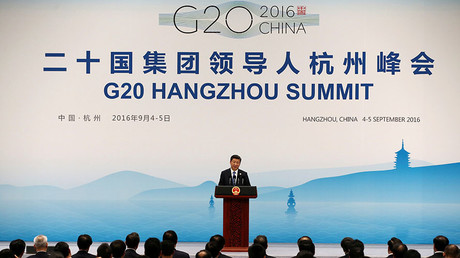
At the recent G20 in Huangzhou, President Xi clearly demonstrated how OBOR is absolutely central to the Chinese vision of how globalization should proceed. Beijing is betting that the overwhelming majority of nations across Eurasia would rather invest in, and profit from, a “win-win” economic development project than be bogged down in a lose-lose strategic game between the US and China.

And that, for the Empire of Chaos, is absolute anathema. How to possibly accept that China is winning the 21st century / New Great Game in Eurasia by building the New Silk Roads?

And don't forget the Silk Road in Syria

Few in the West have noticed, as reported by RT, that the G20 was preceded by an Eastern Economic Forum in Vladivostok. Essentially, that was yet another de facto celebration of Eurasia integration, featuring Russia, China, Japan and South Korea.

And that integration plank will soon merge with the Russia-led Eurasia Economic Union – which in itself is a sort of Russian New Silk Road.

All these roads lead to total connectivity. Take for instance cargo trains that are now regularly linking Guangzhou, the key hub in southeast China, to the logistics center in  Vorsino industrial park near Kaluga. The trip now takes just two weeks – saving no less than a full month if compared with shipping, and around 80 percent of the cost if compared with air cargo.

That’s yet another New Silk Road-style connection between China and Europe via Russia. Still another, vastly more ambitious, will be the high-speed rail expansion of the Transiberian; the Siberian Silk Road.

Then take the closer integration of China and Kazakhstan – which is also a member of the EEU. The duty-free Trans-Eurasia railway is already in effect, from Chongqing in Sichuan across Kazakhstan, Russia, Belarus and Poland all the way to Duisburg in Germany. Beijing and Astana are developing a joint free trade zone at Horgos. And in parallel, a $135 million China-Mongolia Cross-Border Economic Cooperation Zone started to be built last month.

Kazakhstan is even flirting with the ambitious idea of a Eurasian Canal from the Caspian to the Black Sea and then further on to the Mediterranean. Sooner or later Chinese construction companies will come up with a feasibility study.

A virtually invisible Washington agenda in Syria – inbuilt in the Pentagon obsession to not allow any ceasefire to work, or to prevent the fall of its “moderate rebels” in Aleppo – is to break up yet another New Silk Road hub. China has been commercially connected to Syria since the original Silk Road, which snaked through Palmyra and Damascus. Before the Syrian “Arab Spring”, Syrian businessmen were a vital presence in Yiwu, south of Shanghai, the largest wholesale center for small-sized consumer goods in the world, where they would go to buy all sorts of products in bulk to resell in the Levant.

The “American lake”

Neocon/neoliberalcon Washington is totally paralyzed in terms of formulating a response – or at least a counter-proposal - to Eurasia integration. A few solid IQs at least may understand that China’s “threat” to the US is all about economic might. Take Washington’s deep hostility towards the China-driven AIIB (Asia Infrastructure Investment Bank). Yet no amount of hardcore US lobbying prevented allies such as Germany, Britain, Australia and South Korea from joining in.

Then we had the mad dash to approve TPP – the China-excluding, NATO-on-trade arm of the pivot to Asia that was meant to be the cherry of the mostly flat Obama global economic policy cake. Yet the TPP as it stands is practically dead.

What the current geopolitical juncture spells out is the US Navy willing to go no holds barred to stop China from strategically dominating the Pacific, while TPP is deployed as a weapon to stop China dominating Asia-Pacific economically.

With the pivot to Asia configured as a tool to “deter Chinese aggression”, exceptionalists have graphically demonstrated how they are incapable of admitting the whole game is about post-ideological supply chain geopolitics. The US does not need to contain China; what it needs, badly, is key industrial, financial, commercial connection to crucial nodes across Asia to (re)build its economy.

Those were the days, in March 1949, when MacArthur could gloat, “the Pacific is now an Anglo-Saxon lake”. Even after the end of the Cold War the Pacific was a de facto American lake; the US violated Chinese naval and aerial space at will.

Now instead we have the US Army War College and the whole Think Tankland losing sleep over sophisticated Chinese missiles capable of denying US Navy access to the South China Sea. An American lake? No more.

The heart of the matter is that China has made an outstanding bet on infrastructure building – which translates into first-class connectivity to everyone – as the real global 21st century commons, way more important than “security”. After all a large part of global infrastructure still needs to be built. While China turbo-charges its role as the top global infrastructure exporter – from high-speed rail to low-cost telecom - the “indispensable” nation is stuck with a “pivoting”, perplexed, bloated military obsessed with containment.

Divide and rule those “hostile” rivals

Well, things haven’t changed much since Dr. Zbig “Grand Chessboard” Brzezinski dreaming in the late 1990s of a Chinese fragmentation from within, all the way to Obama’s 2015 National Security Strategy, which is no more than futile rhetorical nostalgia about containing Russia, China and Iran.

Thus the basket of attached myths such as “freedom of navigation” - Washington’s euphemism for perennially controlling the sea lanes that constitute China’s supply chain – as well as an apotheosis of “China aggression” incessantly merging with “Russia aggression”; after all, the Eurasia integration-driven Beijing-Moscow strategic partnership must be severed at all costs.

Why? Because US global hegemony must always be perceived as an irremovable force of nature, like death and taxes (Apple in Ireland excluded).

Twenty-four years after the Pentagon’s Defense Planning Guide, the same mindset prevails; “Our first objective is to prevent the reemergence of a new rival…to prevent any hostile power from dominating a region whose resources would, under consolidated control, be sufficient to generate global power. These regions include Western Europe, East Asia, the territory of the former Soviet Union and southwest Asia”.

Oops. Now even Dr. Zbig “Grand Chessboard” Brzezinski is terrified. How to contain these bloody silky roads with Pentagon “existential threats” China and Russia right at the heart of the action? Divide and Rule – what else?

For a confused Brzezinski, the US should“fashion a policy in which at least one of the two potentially threatening states becomes a partner in the quest for regional and then wider global stability, and thus in containing the least predictable but potentially the most likely rival to overreach. Currently, the more likely to overreach is Russia, but in the longer run it could be China.”

Have a pleasant nightmare.

Original Source: Here.

Thursday, September 8, 2016

Tchaikovsky: Capriccio Italien

Пётр Ильи́ч Чайко́вский | Итальянское каприччио op. 45 |

Tuesday, September 6, 2016

Shostakovich: Waltz 2

Шостако́вич | Вальс 2 | Вальс 2 | Вальс 2 |